Xavier Bertels

I’m Head of Product at Phished. Previously CPO at SweepBright and co-founder of Mono.

Artificiële Intelligentie: magische spiegel of museum?

Yep. Weer een tekst over AI. Van iemand die geen AI onderzoeker is. Ik schreef het zelf. Zonder sjet-jie-pie-tie. Mijn referenties? Een breed interesseveld. Ook: 10 jaar in tech en veel zelfstudie. Bedankt om je teleurstelling te verbijten.

Het valt op. Artificiële intelligentie en grote taalmodellen zijn plots overal. Daarmee komt ook het onvermijdelijke op handen dragen of demoniseren. Dat gaat gewoonlijk zo wanneer (sociale)media nieuwigheden oppikken en op grote schaal verspreiden. Mensen delen screenshots die bewijzen hoe slecht ChatGPT in wiskunde is (er zit een taalmodel achter). Of hoe prompt engineers (informatie architect 2.0) meer dan €350 000 per jaar kunnen verdienen. Er zijn ook vragen rond intellectuele eigendom en privacy.

Ik hou van producten. Ik hou er van om te begrijpen wat mensen drijft om iets wel of niet te gebruiken. Vinger aan de pols en blik op de toekomst. In die context denk ik na over waar AI in het leven van mensen past. Waar kan het een verrijking zijn? Wat zijn de principes die ik kan gebruiken om over AI als toepassing na te denken?

Ik zie mensen op twee verschillende manieren artificiële intelligentie gebruiken. De eerste is als magische spiegel, waarin je zelf het meest interessante object bent. Je gebruikt AI om je identiteit te versterken. Denk aan selfies in de stijl van Balenciaga, of je nieuwjaarsbrief herschreven in de stijl van J.K. Rowling. Je eigen gezicht en stem als hoofdrolspeler in de nieuwe Star Wars: It’s Personal. De AI verweeft jouw identiteit in popcultuur en toont jou zo de meest ambitieuze versie van jezelf. Zonder dat je er voor uit bed moet.

Alternatief? Een museum. Een toegankelijke manier om de wereld in een nieuw licht te zien. Een vriendelijke gids die tien richtingen aanwijst op elk kruispunt, zodat je niet meer vast zit in de overtuigingen die je brein tot dan toe stap na stap als wereldbeeld heeft gevormd. Lees met een druk op de knop alternatieve versies van je tekst. Vraag de artificiële intelligentie naar bronnen die over gelijkaardige dingen schreven. Lees. Leer. Innoveer op de schouders van giganten.

De mens zit in imperfectie. In Japan vinden we dat terug in het Wabi-Sabi-idee. Maar ook dichter bij huis vinden we dat al terug in het verhaal van Adam en Eva. Wat de mens menselijk maakt is de mogelijkheid om te kiezen voor dat wat niet mag. Zo verschillen wij van de AI, want die krijgt regels en een doel mee. ChatGPT zal nooit voor een blanco antwoord kiezen. Jij kan er wel voor kiezen om blanco huiswerk af te geven.

Wat in het verleden imperfect was, beschouwen we vandaag soms als perfect. Wanneer het makkelijker wordt om vandaag perfect te zijn door de lens van de geschiedenis, wordt de AI misschien niet enkel een magische spiegel of een museum, maar ook een vliegwiel voor innovatie, gebaseerd op wat we conserveerden.
When Meetings At Work Do Not Work

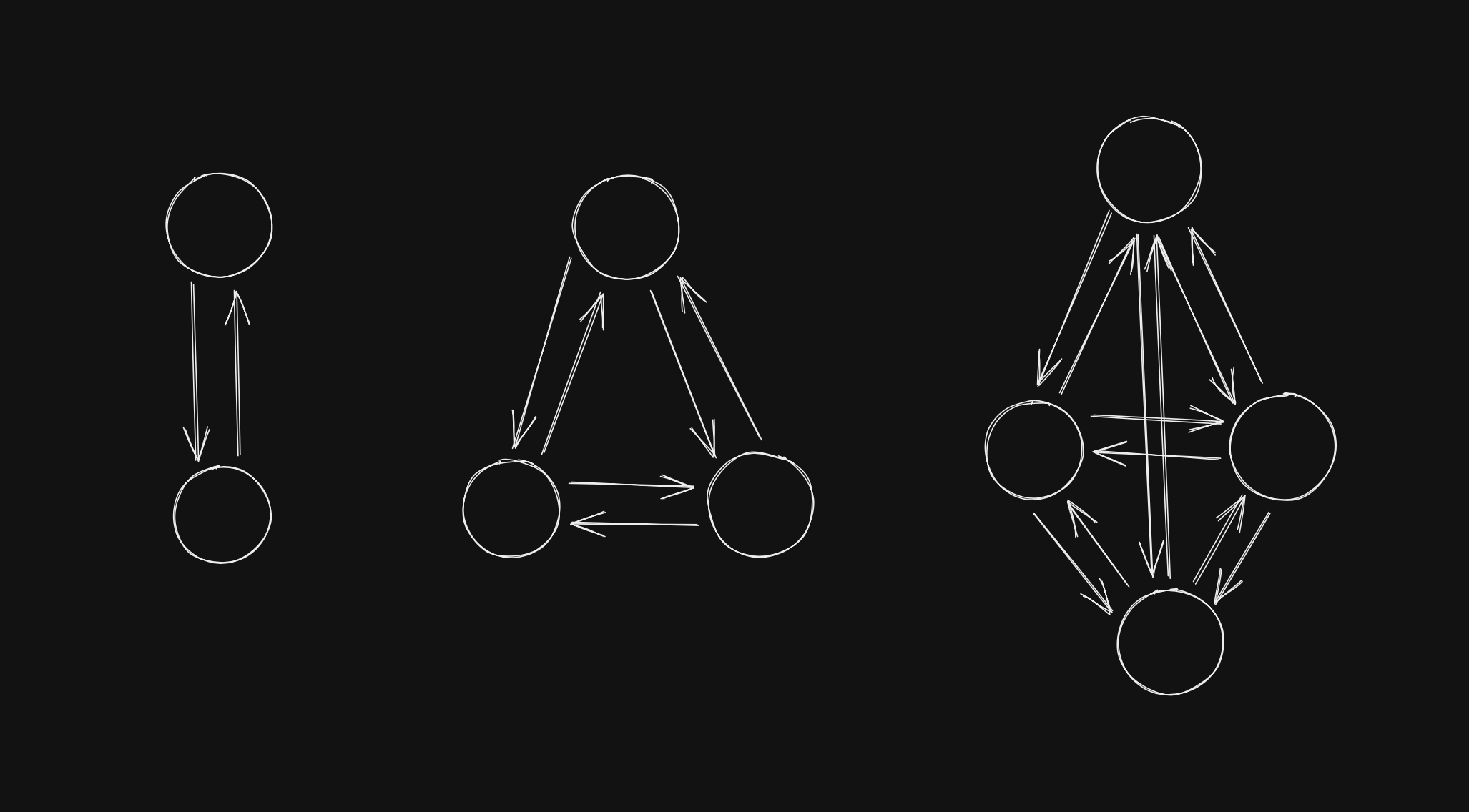
A teacher once scratched the following schema on a blackboard:

A sequence of 2, 3 and 4 orbs, with arrows connecting each orb in two directions

He taught me three things:

1. One more person in a conversation creates an exponentially1 harder communication challenge;
2. visuals stick;
3. a good teacher is invaluable.

Every dot in this schema represents a person, and every line represents a relationship. Let’s say one relationship equals to one unit of effort. If you add one person, the amount of effort in a conversation grows from two to six. Add another and it grows from six to twelve.

It’s fascinating. At five people, the amount of effort in a conversation has grown to twenty! People will zone out, or form side-conversations. They isolate the amount of relationships to maintain. Meetings become classrooms, sans teacher. Chaos. No-meeting factions, pro-meeting factions. One guy in the corner is eating glue.

Slack has entered the chat.

Chat changes everything. Chat allows people to not fill dead space with random thoughts. Chat allows people to form side-conversations. It allows people to maintain relationships more easily. Chat reduces the amount of effort even in very large groups of people.

It is okay to post your thoughts or a question in a channel of 10, 100 or 1000 people. You are not asking everyone to pay attention. And when you do need attention, you can mention people explicitly. Those who have a moment to read, can learn. Others can prioritize their own work.

And sometimes you still need meetings. The path forward?

1. If there are more than four people in the meeting, it is a classroom;
2. bring visuals if you want anything to stick;
3. make way for good teachers.

1 Okay not exactly exponentially but n2-n

Mastodon Is Not the Next Twitter: Why It Is a Different Beast

Mastodon1 is a mostly functional, digital social network. People have called it home for the past decade or so. Today, people are looking to this network as a refuge from twitter, hoping to escape from Elon Musk and find something similar on Mastodon. I believe that is naive. It is vastly different in scope, reach, population diversity and incentive structure compared to twitter–and that is by design.

Twitter has an incentive to have as many users as possible: the revenue model works better when it’s larger. It brings people from wildly different backgrounds together on a single platform. Mastodon groups2 almost have the opposite incentive: big enough to have conversations with like-minded people, but not so big it becomes too hard to manage. User banning decisions, group banning decisions3 or server maintenance and costs make it a complex operation for any reasonably-sized group admin to manage.

What happens when a Mastodon group admin decides to block a prominent political figure? Or when an admin of a bigger Mastodon group decides that you cannot communicate with the entire European Green Party group? Twitter can’t do that. It wouldn’t fly. But who holds the Mastodon admin accountable for these actions? Users who disagree might leave that group to join another and those who agree will stay. The filter bubbles4 on Mastodon are very real because you can block communication with entire groups of people you think you disagree with based on which group they joined–which I believe is the whole point of the Mastodon network. And that’s fine. Sailing the global sea of opinions is not for everyone.

I think we cannot compare the way accountability works on both networks. Twitter is a global melting pot, Mastodon is a local vegan restaurant. They are, and should be held to different accountability standards. If you can’t handle Elon, all you have to do is block his account. But don’t let some group admin make that choice for you.

1 More technical: Mastodon is a service that uses the ActivityPub network standard to speak with other servers that use the same standard. If you’re interested to learn more, there is an excellent Wikipedia article about Mastodon.

2 For simplicity, I call Mastodon instances groups. A Mastodon instance is the server you choose to sign up on. It’s essentially like picking an @gmail.com or @hotmail.com address. You can, most of the time, communicate with other people with an e-mail address that ends differently than your own e-mail address.

3 Also known as defederation.

4 Filter bubble as I intend it here is “isolation from conflicting views” which, ironically, is not what happens on the larger social networks. Although they do struggle with polarisation effects.

Yes, But Later

Time is a product manager’s best friend. It allows us to say no in a way that helps others to let go of their ideas; it’s the best idea in the world, because my favourite person in the world thought of it: me! I tell others yes, but later in stead of no.

You have a conversation with Alexander, a colleague.

“Do we automate manual tasks because it defocuses developers?” Alexander wonders.
“Yep!” you answer.
“I noticed that we sometimes do x. Can we automate it?” he continues.
You answer, “No,” with clarity.
Out of nowhere Alexander drops the bomb, “Why not?”
A soft voice in your head self-reflects, “Help.

The team performs the task seven times in a year. It defocuses three people. It is also complicated to automate and it comes with a maintenance cost.

I have three of these conversations per week. If I handle them like this, I explain the same thing every week. And I am the asshat not willing to engage with obviously the best idea and best person in the world. If you think a roadmap solves this: think again. People have ideas and fire away in your Slack DM’s. There is a better way to handle this.

“Do we automate manual tasks because it defocuses developers?” Alexander wonders.
“Yep!” you answer.
“I noticed that we sometimes do x. Can we automate it?” he continues.
You answer, “Yes, but later.”
Alexander replies pleased, “Great!”

In my experience, time is an overlooked aspect of decision making. We can use time to say no and help people feel heard.

Inevitably someone will say “Great! When?” This is probably the number one reason why roadmaps (that never pan out) do exist: to satisfy the people who think they have really, incredibly important ideas. That’s a great topic too, but later.

Wanderers, Explorers and the Hidden World

In ten years of working with designers, I’ve worked with two people: wanderers and explorers. The wanderer admires the tip of the iceberg. The explorer plunges into the water to discover the hidden world below.

The wanderer enjoys the scenery. He’s good-hearted. No plan. Comes across an iceberg floating in a sea of calm. He decides that he likes the iceberg and doesn’t wonder why it floats, or why it’s shaped that way. He touches, licks and smells the cold, crisp ice. He becomes excited to tell everyone about this beautiful thing.

The explorer saw the wanderer come across something unique. She stands ready to deep-dive into unknown waters. Ready to discover what’s below. At her own risk, she works hard to understand what makes this floating rock of ice so beautiful. She discovers that the ice rock used to be part of a bigger formation. And that it isn’t supposed to float all by itself, way out here. While beautiful in isolation, it’s the result of a problematic, invisible force.

I appreciate the naivety of the wanderer. And I love the grit of the explorer. The wanderer found something and now feels that we should have it too! The explorer figures out that it’s problematic to have more of these.

These are not two people. Designers can find both a wanderer and an explorer in themselves. If you like wandering, try to explore. And if you’re an explorer, try to wander some more.